The Ultimate Guide to Startup Fundraising for First-Time Founders (2026 Edition)
The Ultimate Guide to Startup Fundraising for First-Time Founders (2026 Edition)
The Ultimate Guide to Startup Fundraising for First-Time Founders (2026 Edition)

For a first-time founder, entering the world of venture capital can feel like stepping into a high-stakes game where everyone else already knows the rules. In 2026, the landscape of startup fundraising has matured from the unchecked hype of previous eras into a highly disciplined, execution-focused ecosystem. Investors are prioritizing validated problems, technical execution, and sustainable unit economics over pure vision.
This guide is designed to level the playing field. Drawing from the insights of top venture capitalists, operators, and legal experts, we will break down the exact mechanics, psychology, and best practices of fundraising so you can secure the capital your startup needs to scale.
The Math and Psychology of Venture Capital
Before you pitch a single investor, you must understand how they make money. Venture capital is not structured like a traditional bank loan; it operates on extreme risk and exponential return.
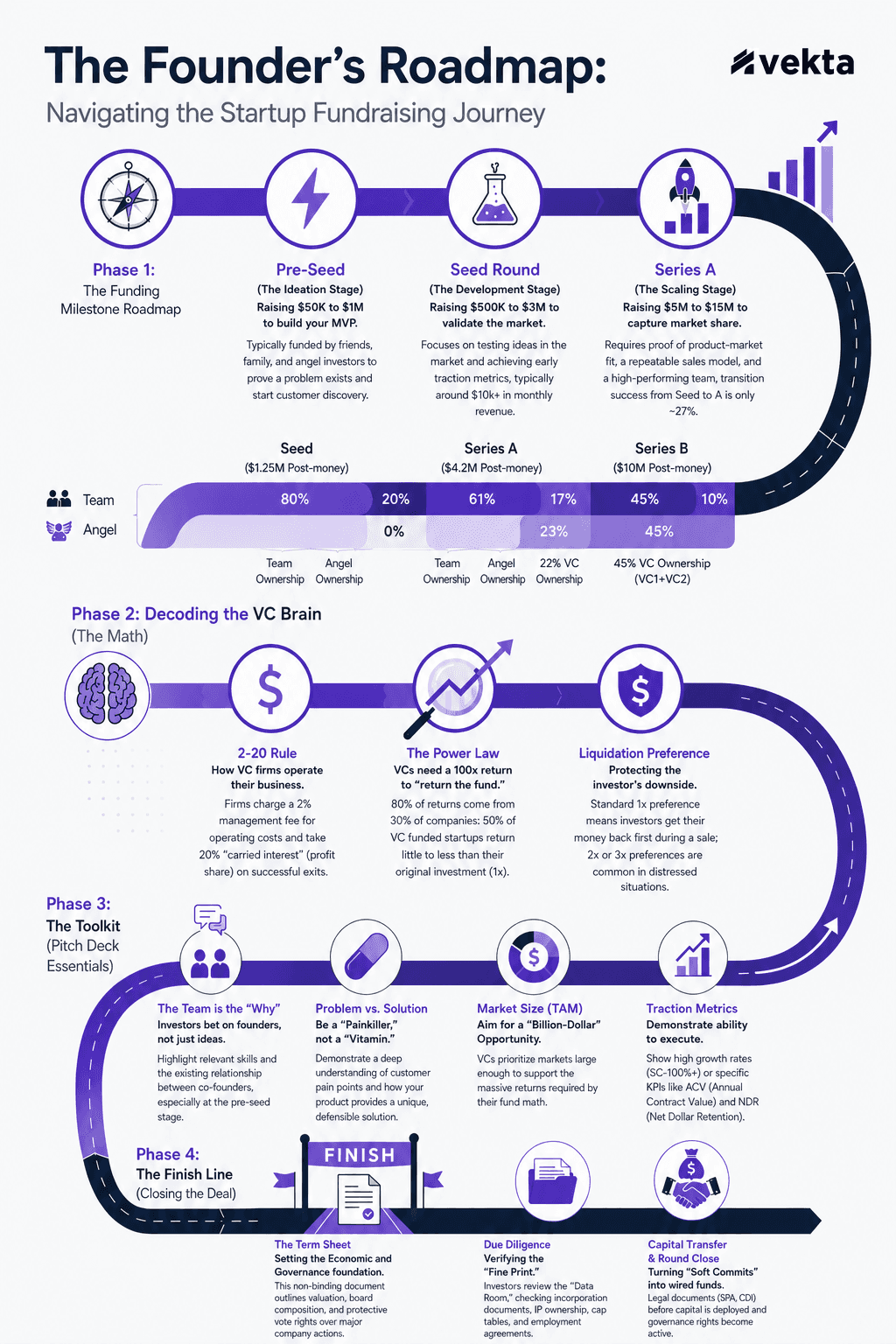
The "2 and 20" Rule A typical VC firm charges its Limited Partners (LPs—the institutions or family offices supplying the capital) a 2% annual management fee and takes 20% of the "carried interest" or profit after returning the initial capital. This means on a $100 million fund, the firm will spend $20 million on operations over 10 years, leaving $80 million to invest. They only earn their 20% bonus if they generate massive returns for their LPs.
The Power Law (Why VCs Need Unicorns) Because early-stage investing is incredibly risky, the math of a VC fund relies on the "Power Law." Out of 10 investments, VCs expect 5 to fail completely, 3 to yield small returns, 1 to be a medium exit, and 1 to be a massive "home run". To return a $100M fund at a standard 3x rate (yielding $300M+), that single home-run company must often exit at $1 billion or more. If your startup cannot realistically reach $100 million in annual revenue within 5 to 10 years, you are not a fit for the venture capital model.
FOMO vs. FOLS Psychologically, VCs are driven by two competing forces: FOMO (Fear Of Missing Out) and FOLS (Fear Of Looking Stupid). They are terrified of passing on the next Uber, but they are equally terrified of looking foolish to their partners by backing a poorly vetted idea. Your job as a founder is to stoke their FOMO by demonstrating momentum and competitive interest, while assuaging their FOLS by proving you are a de-risked, competent operator.
The 5 Ts of Evaluation When de-risking an investment, VCs look at the 5 Ts:
Team: Is the team cohesive and capable of execution?
TAM (Total Addressable Market): Is the market opportunity in the billions?
Technology: Can the product scale exponentially?
Traction: Are you growing rapidly and efficiently?
Trenches: Do you have defensive moats against competitors?
Are You Ready for VC? (And Should You Even Raise?)
Not every business should raise venture capital. As Jive Software's founding CEO Dave Hersh advises, many founders erroneously chase VC as if raising money is the primary goal, which can lead to forced, unsustainable growth and a loss of control. If you can bootstrap, secure government grants, or rely on cash-flow financing, you should do so to keep 100% of your company.
If you are building a hyper-growth company, understand the stages of funding:
Pre-Seed ($100K - $1M): You are validating the problem. You may not have a fully functioning product, but you are running customer discovery. Investors are betting almost entirely on the team and the market.
Seed ($500K - $3M): You have a Minimum Viable Product (MVP) and some early traction or pilots. The goal is to find product-market fit.
Series A ($5M - $15M): You have found product-market fit and need capital to scale sales and marketing. You will typically be generating 2M−3M in revenue.
Angel Investors vs. Venture Capitalists In the Pre-Seed and Seed stages, you will likely encounter Angel Investors. Angels invest their own personal wealth, meaning they do not have to answer to LPs. They can make decisions rapidly after a single meeting and are often more patient with your growth timeline. VCs, conversely, invest institutional money, write larger checks, require board seats, and are rigidly bound to the Power Law timeline.
Mechanics of the Deal – SAFEs, Equity, and Cap Tables
Fundraising introduces complex financial instruments. If you mismanage these, you can lose control of your company.
SAFEs and Dilution (The Pizza Analogy) At the Pre-Seed and Seed stages, you will likely raise using a SAFE (Simple Agreement for Future Equity). A SAFE is not equity today; it is a contract that promises investors equity during a future priced round.
Think of your company as a pizza. Every time you issue a SAFE, you are handing out a "ticket" for a slice of pizza to be claimed later. Originally, Y Combinator created the pre-money SAFE, which made it notoriously difficult for founders to calculate exactly how much of the pizza they had sold. Today, best practice dictates using post-money SAFEs. The math is simple: if you raise $1 million on a 5millionpost−moneyvaluation,youhavesoldexactly201M / $5M = 20%).
The Option Pool Trap When you reach a priced equity round (like a Series A), investors will require you to create an Employee Stock Option Pool (ESOP) to attract top talent. Investors almost always insist that this 10% to 15% pool comes out of the pre-money valuation. This means the dilution is borne entirely by the founders and early employees, not the new investors. You must meticulously model your cap table to ensure that SAFE conversions and the newly created option pool do not dilute your ownership below 50% prematurely.
The 2026 Pitch Deck Playbook
Your company is a product, and your pitch deck is the marketing material used to sell it. An overstuffed, 30-slide deck signals to investors that you lack focus and the ability to prioritize. Keep your deck to 5–10 high-impact slides.
The Essential Pitch Deck Slides:
The Team: In early-stage startups, the team is everything. Investors want to see that you possess an "unfair advantage"—unique industry expertise, technical chops, or a history of shipping products together. In 2026, VCs specifically look for technical competence, recruiting ability, and fundraising skill.
The Problem: Prove that you are selling a "painkiller," not a vitamin. Quantify the problem with specific metrics (e.g., "The average host leaves $2,000/month on the table") to prove the pain is urgent and highly lucrative to solve.
The Solution: Focus on your product vision and differentiation. Do not give a feature list; frame the narrative around why your approach completely reshapes the industry.
The Market (TAM): Show that the market can support a billion-dollar company. Demonstrate this both top-down (industry size) and bottom-up (number of customers × ACV). If you are targeting a niche initially, use the HubSpot model: show how you will dominate a small wedge first, before expanding into a massive enterprise market.
Traction & Go-To-Market: Even if your numbers are small, you must show momentum. Show your CAC (Customer Acquisition Cost), ACV (Annual Contract Value), and how you acquire users. Investors want to see that you can execute rapidly and cheaply.
Running a Tight Fundraising Process
Fundraising is fundamentally an enterprise sales process. You need a CRM, a pipeline, and a timeline.
Timing Your Raise Do not fundraise in August; the venture world virtually shuts down for vacations. The best times to run a process are March through May, and September through November.
Building the Pipeline Create a target list of 20 to 50 VCs. Do your research: ensure they invest in your stage, geography, and sector, and verify they haven't funded a direct competitor. Rank them into tiers. Pitch your lowest-priority investors first to practice your delivery and refine your deck based on their questions. Save your top-tier targets for when your pitch is flawless.
Warm Intros vs. Cold Emails A warm intro from a successful founder in an investor's portfolio is 100x more effective than a cold email. If you must cold email, keep it to three bullet points: what you do, your impressive traction, and a clear call-to-action.
The Investor Newsletter Hack When an investor says "no" or "not right now," ask if you can add them to your monthly investor update newsletter. Send a concise, monthly update detailing your ARR growth, key hires, and goals. VCs invest in lines, not dots. By demonstrating consistent execution month over month, you turn today's "no" into tomorrow's "yes".
Closing the Round and Due Diligence
Getting a verbal "yes" is only halfway to the finish line. The deal is not done until the money is wired to your bank account.
Term Sheet Tactics When a lead investor issues a term sheet, they dictate the economic and control terms of your company. Beware of common VC negotiation tactics:
The Exploding Term Sheet: Some VCs will give you 24 hours to sign to prevent you from shopping their offer to other firms. Push back for a reasonable window (e.g., one week) to review your options.
Protective Provisions: Once you issue preferred equity, investors gain veto rights over major decisions, such as selling the company or taking on debt. Ensure these are strictly defined.
Board Seats: Do not give away board seats to SAFE investors. Reserve formal board seats for lead investors in priced rounds, and include sunset clauses for any observer rights.
Preparing for Due Diligence Investors will dive into your company's data room before wiring funds. A messy data room signals a messy operator. Ensure your legal house is spotless:
IP Assignments: Every founder, employee, and contractor must have signed a Confidentiality and Invention Assignment Agreement (CAIA). If the company does not formally own its IP, the deal will die in diligence.
83(b) Elections: Ensure founders and early employees have filed their IRS 83(b) elections within 30 days of receiving vesting equity to prevent catastrophic tax liabilities.
Clean Corporate Structure: Ensure your Certificate of Incorporation, Bylaws, and Cap Table are perfectly updated. Incorporating as a Delaware C-Corp is the industry standard and provides massive tax benefits like the QSBS (Qualified Small Business Stock) exemption.
Reverse Due Diligence You will be "married" to your VC for the next 7 to 10 years. Do your own reference checks. Ask the VC to introduce you to founders in their portfolio. More importantly, use your network to back-channel and speak to founders whose companies failed under that VC. Ask them: "On a scale of 1-10, how would you rank this investor? And what would they need to do to become a 10?". Their answers will tell you how the investor behaves when things go wrong—which is when you will need them the most.
Conclusion
Raising venture capital in 2026 is a grueling, complex process that filters out all but the most prepared and resilient founders. To succeed, you must master the mechanics of dilution, perfect your narrative, relentlessly manage your pipeline, and protect your company in the closing documents. By applying the strategies outlined in this guide, you will transition from a founder asking for money into a high-leverage operator offering investors a lucrative partnership.
For a first-time founder, entering the world of venture capital can feel like stepping into a high-stakes game where everyone else already knows the rules. In 2026, the landscape of startup fundraising has matured from the unchecked hype of previous eras into a highly disciplined, execution-focused ecosystem. Investors are prioritizing validated problems, technical execution, and sustainable unit economics over pure vision.
This guide is designed to level the playing field. Drawing from the insights of top venture capitalists, operators, and legal experts, we will break down the exact mechanics, psychology, and best practices of fundraising so you can secure the capital your startup needs to scale.
The Math and Psychology of Venture Capital
Before you pitch a single investor, you must understand how they make money. Venture capital is not structured like a traditional bank loan; it operates on extreme risk and exponential return.
The "2 and 20" Rule A typical VC firm charges its Limited Partners (LPs—the institutions or family offices supplying the capital) a 2% annual management fee and takes 20% of the "carried interest" or profit after returning the initial capital. This means on a $100 million fund, the firm will spend $20 million on operations over 10 years, leaving $80 million to invest. They only earn their 20% bonus if they generate massive returns for their LPs.
The Power Law (Why VCs Need Unicorns) Because early-stage investing is incredibly risky, the math of a VC fund relies on the "Power Law." Out of 10 investments, VCs expect 5 to fail completely, 3 to yield small returns, 1 to be a medium exit, and 1 to be a massive "home run". To return a $100M fund at a standard 3x rate (yielding $300M+), that single home-run company must often exit at $1 billion or more. If your startup cannot realistically reach $100 million in annual revenue within 5 to 10 years, you are not a fit for the venture capital model.
FOMO vs. FOLS Psychologically, VCs are driven by two competing forces: FOMO (Fear Of Missing Out) and FOLS (Fear Of Looking Stupid). They are terrified of passing on the next Uber, but they are equally terrified of looking foolish to their partners by backing a poorly vetted idea. Your job as a founder is to stoke their FOMO by demonstrating momentum and competitive interest, while assuaging their FOLS by proving you are a de-risked, competent operator.
The 5 Ts of Evaluation When de-risking an investment, VCs look at the 5 Ts:
Team: Is the team cohesive and capable of execution?
TAM (Total Addressable Market): Is the market opportunity in the billions?
Technology: Can the product scale exponentially?
Traction: Are you growing rapidly and efficiently?
Trenches: Do you have defensive moats against competitors?
Are You Ready for VC? (And Should You Even Raise?)
Not every business should raise venture capital. As Jive Software's founding CEO Dave Hersh advises, many founders erroneously chase VC as if raising money is the primary goal, which can lead to forced, unsustainable growth and a loss of control. If you can bootstrap, secure government grants, or rely on cash-flow financing, you should do so to keep 100% of your company.
If you are building a hyper-growth company, understand the stages of funding:
Pre-Seed ($100K - $1M): You are validating the problem. You may not have a fully functioning product, but you are running customer discovery. Investors are betting almost entirely on the team and the market.
Seed ($500K - $3M): You have a Minimum Viable Product (MVP) and some early traction or pilots. The goal is to find product-market fit.
Series A ($5M - $15M): You have found product-market fit and need capital to scale sales and marketing. You will typically be generating 2M−3M in revenue.
Angel Investors vs. Venture Capitalists In the Pre-Seed and Seed stages, you will likely encounter Angel Investors. Angels invest their own personal wealth, meaning they do not have to answer to LPs. They can make decisions rapidly after a single meeting and are often more patient with your growth timeline. VCs, conversely, invest institutional money, write larger checks, require board seats, and are rigidly bound to the Power Law timeline.
Mechanics of the Deal – SAFEs, Equity, and Cap Tables
Fundraising introduces complex financial instruments. If you mismanage these, you can lose control of your company.
SAFEs and Dilution (The Pizza Analogy) At the Pre-Seed and Seed stages, you will likely raise using a SAFE (Simple Agreement for Future Equity). A SAFE is not equity today; it is a contract that promises investors equity during a future priced round.
Think of your company as a pizza. Every time you issue a SAFE, you are handing out a "ticket" for a slice of pizza to be claimed later. Originally, Y Combinator created the pre-money SAFE, which made it notoriously difficult for founders to calculate exactly how much of the pizza they had sold. Today, best practice dictates using post-money SAFEs. The math is simple: if you raise $1 million on a 5millionpost−moneyvaluation,youhavesoldexactly201M / $5M = 20%).
The Option Pool Trap When you reach a priced equity round (like a Series A), investors will require you to create an Employee Stock Option Pool (ESOP) to attract top talent. Investors almost always insist that this 10% to 15% pool comes out of the pre-money valuation. This means the dilution is borne entirely by the founders and early employees, not the new investors. You must meticulously model your cap table to ensure that SAFE conversions and the newly created option pool do not dilute your ownership below 50% prematurely.
The 2026 Pitch Deck Playbook
Your company is a product, and your pitch deck is the marketing material used to sell it. An overstuffed, 30-slide deck signals to investors that you lack focus and the ability to prioritize. Keep your deck to 5–10 high-impact slides.
The Essential Pitch Deck Slides:
The Team: In early-stage startups, the team is everything. Investors want to see that you possess an "unfair advantage"—unique industry expertise, technical chops, or a history of shipping products together. In 2026, VCs specifically look for technical competence, recruiting ability, and fundraising skill.
The Problem: Prove that you are selling a "painkiller," not a vitamin. Quantify the problem with specific metrics (e.g., "The average host leaves $2,000/month on the table") to prove the pain is urgent and highly lucrative to solve.
The Solution: Focus on your product vision and differentiation. Do not give a feature list; frame the narrative around why your approach completely reshapes the industry.
The Market (TAM): Show that the market can support a billion-dollar company. Demonstrate this both top-down (industry size) and bottom-up (number of customers × ACV). If you are targeting a niche initially, use the HubSpot model: show how you will dominate a small wedge first, before expanding into a massive enterprise market.
Traction & Go-To-Market: Even if your numbers are small, you must show momentum. Show your CAC (Customer Acquisition Cost), ACV (Annual Contract Value), and how you acquire users. Investors want to see that you can execute rapidly and cheaply.
Running a Tight Fundraising Process
Fundraising is fundamentally an enterprise sales process. You need a CRM, a pipeline, and a timeline.
Timing Your Raise Do not fundraise in August; the venture world virtually shuts down for vacations. The best times to run a process are March through May, and September through November.
Building the Pipeline Create a target list of 20 to 50 VCs. Do your research: ensure they invest in your stage, geography, and sector, and verify they haven't funded a direct competitor. Rank them into tiers. Pitch your lowest-priority investors first to practice your delivery and refine your deck based on their questions. Save your top-tier targets for when your pitch is flawless.
Warm Intros vs. Cold Emails A warm intro from a successful founder in an investor's portfolio is 100x more effective than a cold email. If you must cold email, keep it to three bullet points: what you do, your impressive traction, and a clear call-to-action.
The Investor Newsletter Hack When an investor says "no" or "not right now," ask if you can add them to your monthly investor update newsletter. Send a concise, monthly update detailing your ARR growth, key hires, and goals. VCs invest in lines, not dots. By demonstrating consistent execution month over month, you turn today's "no" into tomorrow's "yes".
Closing the Round and Due Diligence
Getting a verbal "yes" is only halfway to the finish line. The deal is not done until the money is wired to your bank account.
Term Sheet Tactics When a lead investor issues a term sheet, they dictate the economic and control terms of your company. Beware of common VC negotiation tactics:
The Exploding Term Sheet: Some VCs will give you 24 hours to sign to prevent you from shopping their offer to other firms. Push back for a reasonable window (e.g., one week) to review your options.
Protective Provisions: Once you issue preferred equity, investors gain veto rights over major decisions, such as selling the company or taking on debt. Ensure these are strictly defined.
Board Seats: Do not give away board seats to SAFE investors. Reserve formal board seats for lead investors in priced rounds, and include sunset clauses for any observer rights.
Preparing for Due Diligence Investors will dive into your company's data room before wiring funds. A messy data room signals a messy operator. Ensure your legal house is spotless:
IP Assignments: Every founder, employee, and contractor must have signed a Confidentiality and Invention Assignment Agreement (CAIA). If the company does not formally own its IP, the deal will die in diligence.
83(b) Elections: Ensure founders and early employees have filed their IRS 83(b) elections within 30 days of receiving vesting equity to prevent catastrophic tax liabilities.
Clean Corporate Structure: Ensure your Certificate of Incorporation, Bylaws, and Cap Table are perfectly updated. Incorporating as a Delaware C-Corp is the industry standard and provides massive tax benefits like the QSBS (Qualified Small Business Stock) exemption.
Reverse Due Diligence You will be "married" to your VC for the next 7 to 10 years. Do your own reference checks. Ask the VC to introduce you to founders in their portfolio. More importantly, use your network to back-channel and speak to founders whose companies failed under that VC. Ask them: "On a scale of 1-10, how would you rank this investor? And what would they need to do to become a 10?". Their answers will tell you how the investor behaves when things go wrong—which is when you will need them the most.
Conclusion
Raising venture capital in 2026 is a grueling, complex process that filters out all but the most prepared and resilient founders. To succeed, you must master the mechanics of dilution, perfect your narrative, relentlessly manage your pipeline, and protect your company in the closing documents. By applying the strategies outlined in this guide, you will transition from a founder asking for money into a high-leverage operator offering investors a lucrative partnership.

Investors are driven by two competing emotions: FOMO (Fear Of Missing Out) and FOLS (Fear Of Looking Stupid).
Blogs / Insights